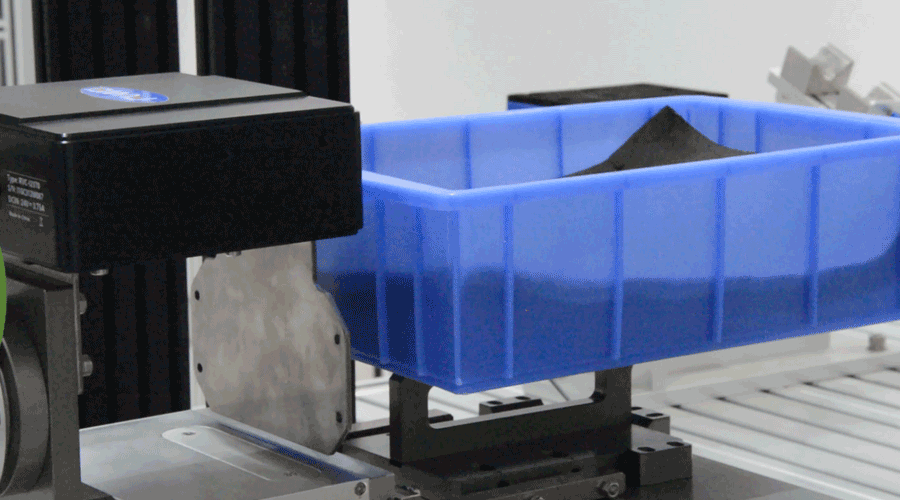
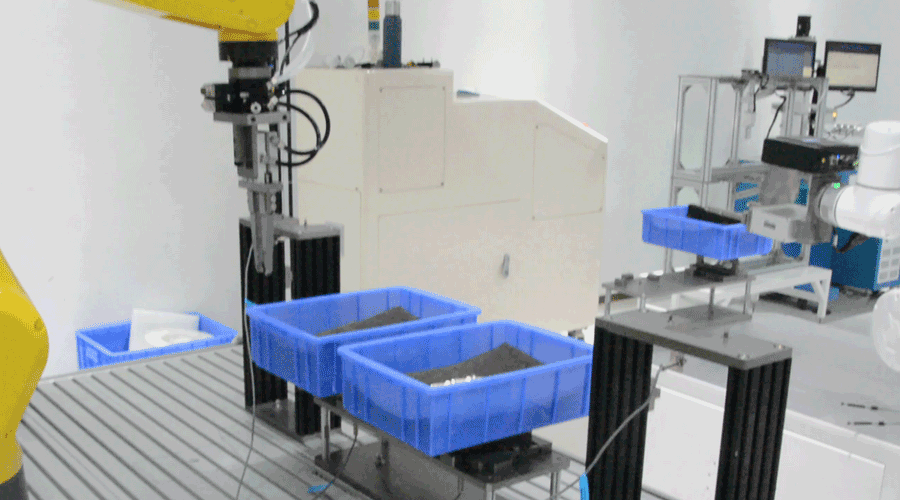
3D Vision Guided Spark Plug Automatic Loading and Unloading Solution: Say Goodbye to "Manual Sorting and Fatigue Operations" in Precision Assembly

Overview
In the manufacturing process of automotive spark plugs, the inspection, sorting, and potting of ceramic blanks rely on manual labor for a long time, which not only results in low efficiency but also poses risks of misoperation and safety hazards. We use 3D structured light cameras, composite robots, and self-developed AI algorithms as our core to provide intelligent loading and unloading capabilities for spark plug production lines, including "disorderly grasping, precise placement, and 7x24 hour uninterrupted". From porcelain billet inspection to loading and transportation, the entire process is automated, fully unleashing the potential of the production line.
Core Value Overview:
Precision breakthrough: The 3D visual positioning accuracy is less than ± 1mm, and the hand eye calibration accuracy is less than 1mm, meeting the requirements of precision assembly.
Flexible compatibility: Adapts to multiple products, supports quick change fixtures, and does not require mechanical adjustment for changing models.
Environmental adaptation: The 3D structured light camera has strong anti-interference ability and can adapt to complex lighting changes in factories.
Efficiency Revolution: 7x24 non-stop operation, replacing manual sorting and handling, increasing efficiency by over 200%.
Rapid deployment: self-developed algorithm for building workpiece models, quickly adapting to new workpieces, and reducing deployment cycles to 3 days.
Are you facing the pain of "spark plug loading and unloading"?
Pain point 1: The factory environment is complex and the lighting changes greatly
The workstation is located at the entrance or window of the factory, where the lighting changes dramatically in the morning and evening. Traditional 2D vision has a sharp decline in recognition rate under strong or weak light conditions, resulting in frequent misjudgments and grasping failures.
Pain point 2: Multiple products mixed production, frequent fixture switching
There are various types of spark plugs, and different specifications of ceramic bodies and shells require different clamping methods. Traditional fixed fixtures are incompatible, and manual replacement is required during the changeover process, which can take several hours.
Pain point 3: There are many types of fixtures and jigs, and the flexibility is insufficient
The production line needs to adapt to a large number of fixtures and jigs, and traditional non-standard automation equipment lacks flexibility when facing diverse demands, resulting in high changeover costs and long cycles.
Pain point 4: Fast compatibility with multiple products, which traditional devices cannot achieve
The market's demand for multiple varieties and small batches is increasing day by day, and traditional fixed automation equipment cannot quickly switch products, becoming a bottleneck for flexible production.
Pain point 5: Strict precision requirements, grasping accuracy needs to be controlled within 1mm
Spark plug ceramic blanks are precision components that require extremely high positioning accuracy for grasping and placing. Manual operation is difficult to maintain stability in the long term, and ordinary automation solutions are difficult to meet the industry standard of ± 1mm.
Pain point 6: Visual recognition of symmetrical parts is difficult, and traditional positioning is prone to errors
The spark plug housing and other workpieces are mostly symmetrical structures, and traditional 2D vision cannot distinguish between the front and back sides and angles, resulting in incorrect placement direction and affecting subsequent assembly.
Our solution: 3D vision+composite robot+self-developed algorithm to systematically solve the problem of loading and unloading spark plugs
Core 1: 3D structured light camera+self-developed high-precision positioning algorithm - solving the visual problem of "large lighting changes and difficult recognition of symmetrical parts"
Pain point connection: The factory's lighting changes dramatically, rendering traditional 2D vision ineffective; The symmetrical structure of the spark plug causes positioning errors.
Solution: Using a 3D structured light camera, the 3D point cloud data of the workpiece is obtained by projecting encoded light, which is not affected by environmental lighting and can stably recognize various surface materials (including metal reflectors). Paired with self-developed high-precision 3D visual positioning algorithm, achieving a positioning accuracy of less than ± 1mm.
Technical Highlights:
Supporting the simultaneous production of multiple workpieces, our self-developed workpiece model construction algorithm can adaptively adjust the camera position.
Our self-developed 3D hand eye calibration technology has a calibration accuracy of less than 1mm, ensuring precise collaboration between the robot and the vision system.
Core 2: Composite robot+quick change fixture - solving the flexible adaptation problem of "mixed production of multiple products and complicated fixture switching"
Pain point connection: There are many types of spark plugs, and manual replacement of fixtures is required during the replacement process, which takes several hours.
Solution: The composite robot is equipped with a quick change fixture (tool quick change system), which can automatically switch the end effector according to the product model and is compatible with different specifications of spark plug ceramic blanks and shells. The clamping surface of the fixture is designed with grooves customized according to the size of the workpiece. The groove surface is covered with soft material, and stable and non-destructive clamping is achieved through material deformation during clamping.
Composite robot configuration:
Using laser SLAM navigation technology, the parking positioning accuracy is ± 5mm, and there is no need to lay magnetic strips or QR codes.
Support automatic charging, automatically recharge when the battery level is below the set value, meeting the requirement of 7x24 hour uninterrupted work.
Core 3: System linkage and intelligent production line integration - achieving seamless collaboration of "workstation linkage operations"
Pain point connection: Robots need to collaborate with conveyor belts, detection equipment, discharge machines, turntables, and other devices, making traditional multi system integration complex.
Solution: The system is based on standard industrial protocols such as Modbus TCP and OPC UA, achieving seamless integration with equipment such as conveyor belts, visual inspection cameras, discharge machines, and turntables.
Linkage workflow:
Transportation and Inspection: The conveyor belt transports the spark plug ceramic blank to the visual inspection station, and the camera performs quality inspection on the ceramic blank. Qualified products enter the discharge machine tray, while unqualified products are directed into the waste recycling bin.
Discharge and preparation: The receiving tray on the discharge machine arranges qualified porcelain blanks according to the set quantity, waiting for the robot to grab them.
Grasping and Placement: The composite robot uses end fixtures to grasp the arranged ceramic blanks and places them into the crucible bowl (container) on the turntable according to the preset path.
Rotary table and output: After the crucible bowl in the working position is filled, the rotary table automatically rotates the full bowl out and the empty bowl into the working position. The cylinder performs secondary positioning on the empty bowl to ensure placement accuracy.
Value output: Achieve full process automation from incoming material inspection to port loading output, reduce manual intervention, and improve the overall automation and intelligence level of the production line.
Core 4: Self developed AI algorithm and intelligent control platform - solving the software problem of "difficult path planning and low collaborative efficiency"
Solution: Adopt self-developed AI edge controller as the overall control of the production line to achieve signal interaction and unified scheduling of composite robots, conveyor belts, detection equipment, turntables and other devices.
Algorithm capability:
A deep learning based object detection and localization algorithm, intelligent robotic arm obstacle avoidance and trajectory planning algorithm, can adapt to scenarios where multiple workpieces are produced simultaneously.
Our self-developed algorithm for constructing workpiece models enables adaptive adjustment of camera positions without the need for manual intervention.
Summary of Core Technical Indicators
| Serial number | Technical elements | Key metrics | Solve pain points |
|---|
| 1 | 3D structured light camera | Positioning accuracy<± 1mm | Significant changes in lighting conditions and difficulty in identifying symmetrical components |
| 2 | Self developed hand eye calibration | Calibration accuracy<1mm | Visual and Robot Collaborative Accuracy |
| 3 | Quick change fixture | Automatic switching, compatible with multiple models | Multiple products mixed production, slow changeover |
| 4 | Laser SLAM navigation | Parking accuracy ± 5mm | Complex environment and high navigation requirements |
| 5 | Automatic charging | 7x24h uninterrupted | Long cycle continuous production requirements |
| 6 | AI intelligent scheduling | Multi device collaboration and path optimization | Workstation linkage operation and collaborative efficiency |
Why choose our solution?
| Dimension | Traditional manual/basic automation solutions | Intelligent Composite Robot Solution | Increase margin |
|---|
| Precision | Affected by fatigue, high error rate | 3D visual guidance, with an accuracy of<± 1mm | Improve accuracy by 5 times |
| Flexible | Changing the model requires mechanical adjustment and has a long cycle | Quick change fixture+graphical configuration | 90% reduction in changeover time |
| Efficiency | Low daily processing limit, difficult to sustain | 7x24h+automatic charging | Throughput increased by 200%+ |
| Adaptability | Light changes are prone to failure | 3D structured light, strong anti-interference ability | Stable operation throughout the day |
| Compatibility | Exclusive for a single product | Adaptive multiple workpieces | Compatible with 95%+spark plug models |
| Deploy | Weeks to months | 3-day standard deployment | Delivery efficiency increased by 95% |
Relevant cases