Composite Robot + Transfer Robot Collaborative Operation Solution: Unlock the "Last Mile" of In-Plant Logistics
Overview
In the era of intelligent manufacturing, a single robot can hardly meet the complex and variable material flow requirements. Centered on the collaborative operation of composite robot AMR and transfer robot AGV, we build a full-link automated closed loop of "bin position management - material handling - floor transfer". It enables robots to perform their respective duties and work efficiently together, completely breaking the stagnation points of in-factory logistics and realizing seamless material flow from rack to production line and from floor to floor.
Quick Overview of Core Values
Efficiency Multiplication: AMR is responsible for precise picking & placing and bin position management, while AGV takes charge of long-distance transfer. Division of labor and collaboration improves overall efficiency by more than 200%.
Leading Precision: The maximum picking & placing accuracy of composite robot can reach ±0.05mm (2D) / ±0.2mm (3D), satisfying the operation requirements of precision material handling.
Seamless Integration: Self-developed integrated control system dispatches multiple types of robots uniformly to realize task allocation, intelligent avoidance and flexible charging closed loop.
Flexible Deployment: Laser SLAM navigation requires no environmental reconstruction and can quickly adapt to complex factory scenarios.
7×24h Non-stop Operation: Supports automatic charging to meet the demand for all-weather continuous production.
2. Technical Difficulties
Are you facing these "pain points of multi-robot collaboration"?
Difficulty 1: Complex factory environment with multiple types of equipment "coexisting in one space"
Multiple types of entities including production equipment, composite robots, transfer robots and manual operations work simultaneously in the same area. Dense equipment layout, narrow passages and mixed operation of personnel and vehicles place extremely high requirements on the robot's perception, obstacle avoidance and path planning capabilities.
Difficulty 2: High navigation accuracy requirement and complex collision avoidance decision-making
Composite robots and transfer robots need to perform autonomous navigation in narrow passages with parking positioning accuracy up to ±5mm. Meanwhile, issues such as mutual avoidance, priority decision-making and deadlock prevention when multiple robots operate concurrently pose technical challenges that traditional scheduling systems struggle to handle.
Difficulty 3: Inter-device signal interaction: "chaotic and tangled"
The operation signal interaction among production equipment, composite robots and transfer robots is cumbersome, involving docking of multiple brands, multiple protocols and multiple interfaces. How to achieve smooth collaboration of "mutual communication and understanding" is the core problem of system integration.
Difficulty 4: "Accumulated precision error" in collaborative operation
The positioning error after AMR arrives at the target position may superimpose with the motion error of the manipulator itself, leading to offset during picking and placing. Eliminating accumulated errors to ensure accurate grabbing and placing every time is a key bottleneck for composite robot deployment.
Difficulty 5: Fault handling and system robustness challenges
In a multi-robot collaboration system, single-point faults are inevitable. When one robot is abnormal, how to quickly adjust task allocation and ensure continuous overall production tasks is an important indicator to test system maturity.
3. Solution
Our Solution: AI Edge Controller + Integrated Scheduling + High-precision Navigation to systematically solve multi-robot collaboration problems
Core 1: FUWEI AI Edge Controller — Solve integration problems of "cumbersome signal interaction and difficult system docking"
Pain Point: Production equipment, composite robots and transfer robots are from different brands with diverse protocols, leading to cumbersome operation signal interaction.
Solution: Adopt FUWEI AI Edge Controller as the on-site production master controller to realize signal interaction and processing among composite robots, transfer robots and production equipment, and receive production instructions from on-site production systems (such as MES, WMS).
Technical Highlight: The edge controller integrates multiple communication interfaces, supports standard industrial protocols including Modbus TCP, OPC UA and EtherCAT to achieve "plug-and-play" equipment interconnection.
Value Output: The system integration cycle is shortened from several months to several weeks; multi-device signal interaction achieves zero delay and no conflict.
Core 2: Self-developed Robot Integrated Control System — Solve scheduling problems of "chaotic multi-robot scheduling and difficult collision avoidance"
Pain Point: When multiple composite robots and transfer robots work simultaneously, path conflicts, uneven task allocation and unreasonable charging timing frequently occur.
Solution: Adopt self-developed robot integrated control system to realize unified scheduling, task allocation, intelligent avoidance and flexible charging for composite robots and transfer robots. The built-in multi-robot path search and traffic management functions can effectively prevent and resolve deadlocks.
Technical Highlights
Based on the global optimization cost function, the task allocation scheme considering overall situation from bottom layer realizes the "carpooling batch delivery mode", completes material transportation with the shortest path, and maximizes robot utilization rate and transportation efficiency.
The system can automatically plan the charging time and duration of each robot to realize "uninterrupted charging", ensuring no impact on production takt.
Value Output: Multi-robot collaboration efficiency increased by more than 50%, empty load rate reduced by 60%, and charging management fully automated.
Core 3: Laser SLAM Navigation + High-precision Picking & Placing — Solve execution problems of "low navigation precision and large picking/placement deviation"
Pain Point: Complex factory environment and uneven ground make traditional magnetic stripe / QR code navigation hard to adapt; high precision requirements in multi-robot scenarios and accumulated errors affect picking and placing accuracy.
Solution
Navigation System: Both composite robots and transfer robots adopt laser SLAM navigation technology. No magnetic stripes or QR codes are required for laying, and parking positioning accuracy reaches ±5mm.
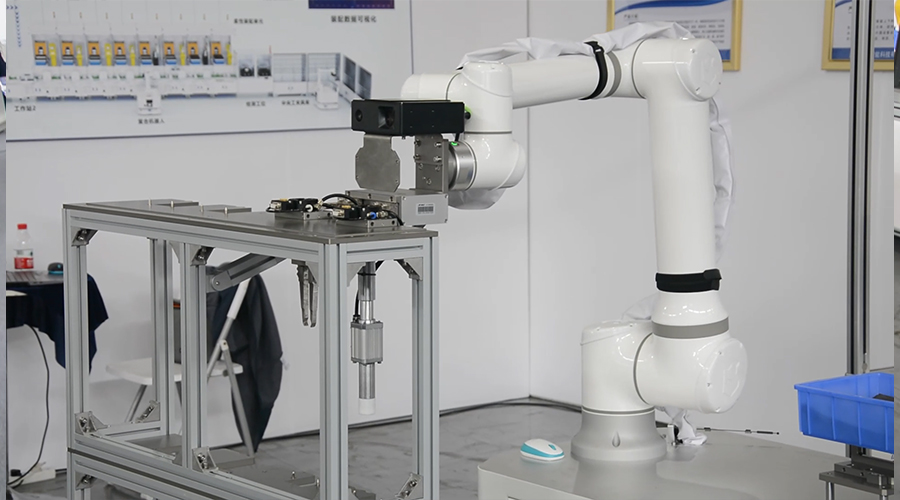
Picking & Placing System: Composite robot is equipped with 2D or 3D camera. Conventional picking & placing accuracy reaches ±0.2mm (2D) / ±0.5mm (3D), with the highest accuracy up to ±0.05mm (2D) / ±0.2mm (3D), enabling high-precision identification and picking & placing of products.
Value Output: Dual guarantee of navigation accuracy and picking/placement accuracy ensures the stability and consistency of material flow, meeting strict requirements of precision manufacturing scenarios.
Core 4: Collaborative Process Design — Realize full-link automation of "products from rack to designated position"
Pain Point: Material flow from rack picking to production line involves multiple workstations and multi-floor transfer, which cannot be completed independently by a single traditional robot.
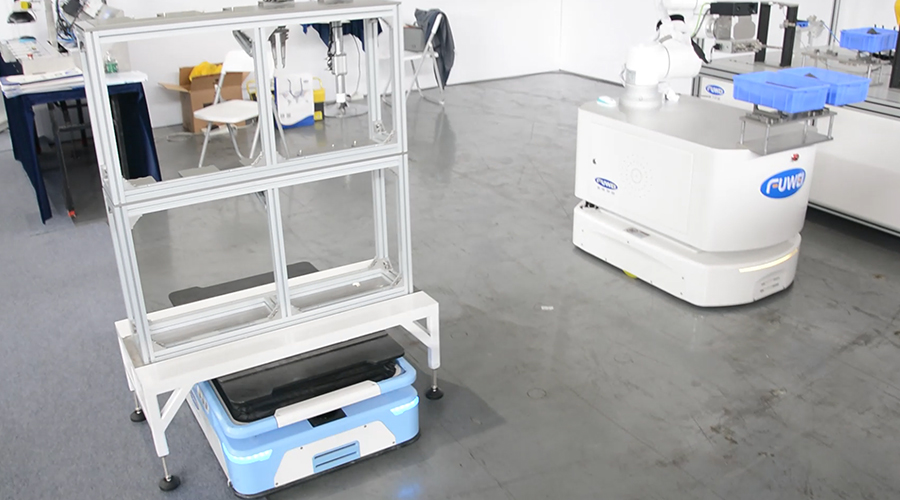
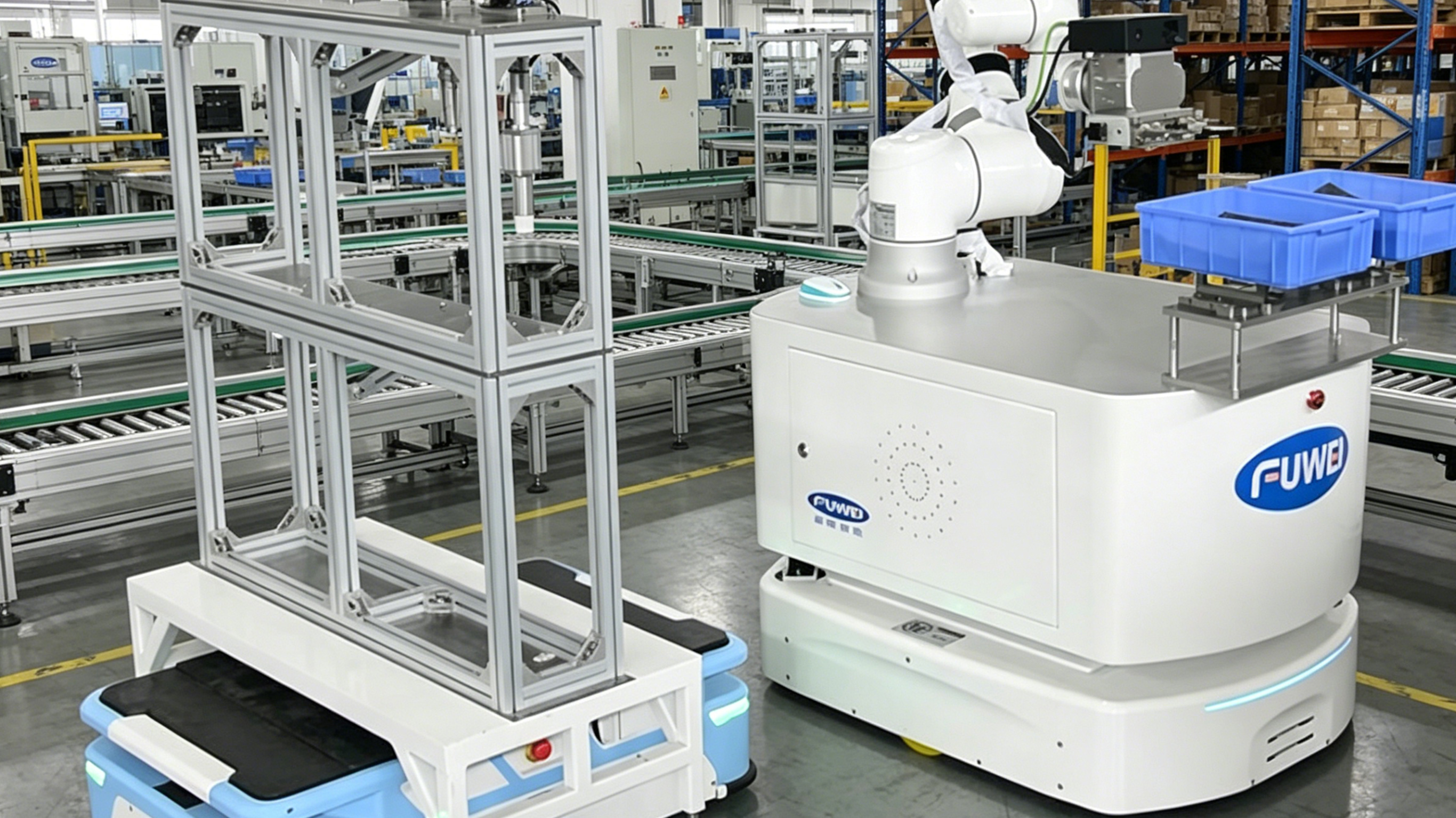
Solution: Through the division of labor and collaboration between composite robot AMR and transfer robot AGV, build a complete material flow closed loop:
AMR for bin position management: Precisely pick and place material bins from racks and manage inventory information.
AMR transfers material bins to AGV rack: Complete material bin transfer at the docking station.
AGV for long-distance transfer: Transport material bins to designated stations or across floors.
Empty Load Return & Cycle: AGV returns after completing transportation and waits for next task allocation.
Value Output: Realize full-link automation of "Rack → AGV → Production Line", and manual handling volume is reduced by more than 90%.
4. Core Advantages & Value
Why choose our solution?
| Dimension | Traditional Single-machine / Manual Solution | Intelligent Collaborative Solution | Improvement |
|---|
| Collaboration Efficiency | Single machine operation, frequent path conflicts | Multi-robot collaboration, intelligent scheduling | Efficiency increased by over 50% |
| Picking & Placing Precision | Affected by fatigue / positioning, high error | ±0.05mm (2D) / ±0.2mm (3D) | Precision improved by 10 times |
| Navigation Precision | Magnetic stripe / QR code required for laying, troublesome maintenance | Laser SLAM, ±5mm parking accuracy | Deployment efficiency increased by 80% |
| System Integration | Multiple independent systems, complex docking | Unified scheduling by edge controller | Integration cycle shortened by 70% |
| Flexible Expansion | Fixed route, hard to adjust | Graphic configuration, fast switching | Changeover time shortened by 90% |
| Non-stop Operation | Manual shift change and charging management required | Automatic charging, 7×24h non-stop | Throughput increased by 200% |
Relevant Cases