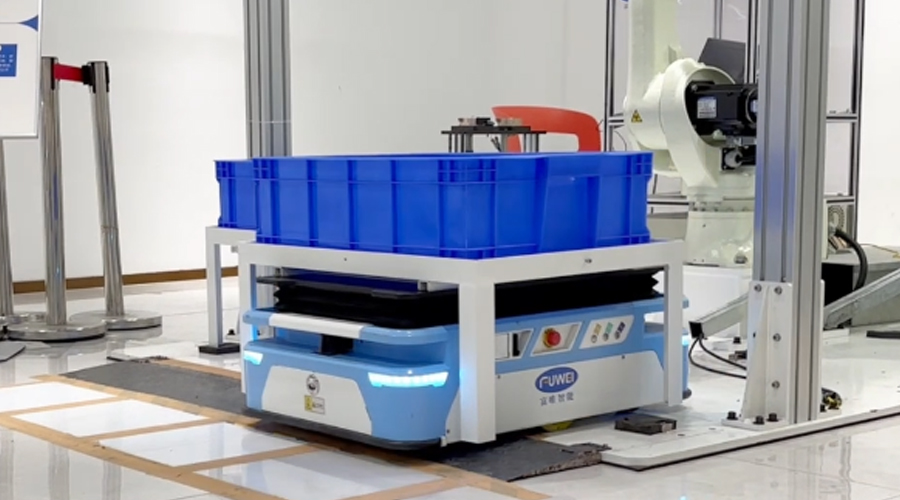
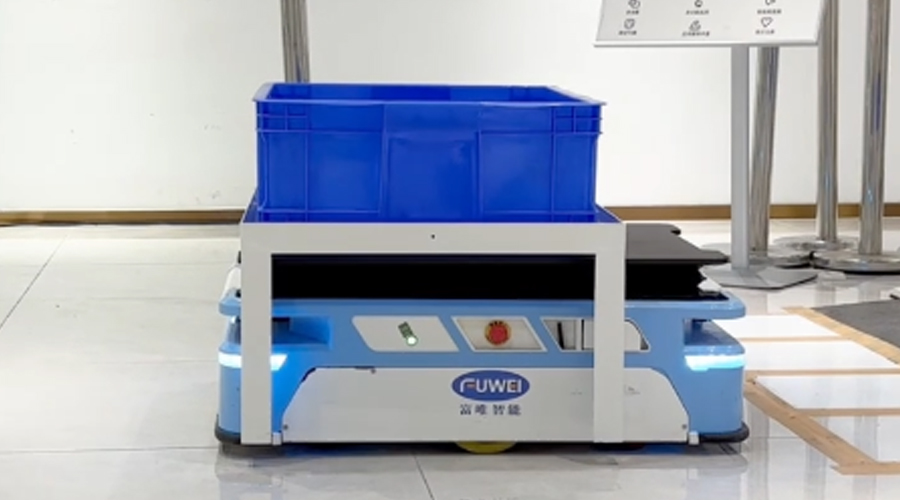
Heavy-load AGV Transfer Robot Solution: Win by Stability, Redefine Automated Handling of Heavy Materials
Overview
In heavy industry manufacturing and warehouse logistics, automated handling of heavy materials ranging from tens of tons has long been an industry challenge, including inertial impact, guaranteed positioning accuracy and complex multi-robot collaboration. Centered on full-load coverage from 600kg to 80 tons, Laser SLAM navigation and AI edge controller, we provide intelligent transfer solutions featuring "stable operation, high-precision positioning and 7×24-hour non-stop operation" for heavy machinery, new energy, metallurgy and other industries. Make every heavy-load transfer as stable as solid rock.
Quick Overview of Core Values
Full-load Coverage: Multiple models ranging from 600kg to 80 tons to meet heavy-load demands of various industries.
High-precision Navigation: Laser SLAM navigation with parking positioning accuracy of ±5mm, adaptable to complex factory environments.
Anti-sway Stability: Multi-axis coordinated control + mechanical vibration damping system for stable operation under heavy load conditions.
Intelligent Scheduling: Unified scheduling by AI edge controller, multi-robot collaboration, intelligent obstacle avoidance and flexible charging.
7×24h Operation: Automatic charging technology to support all-weather continuous production.
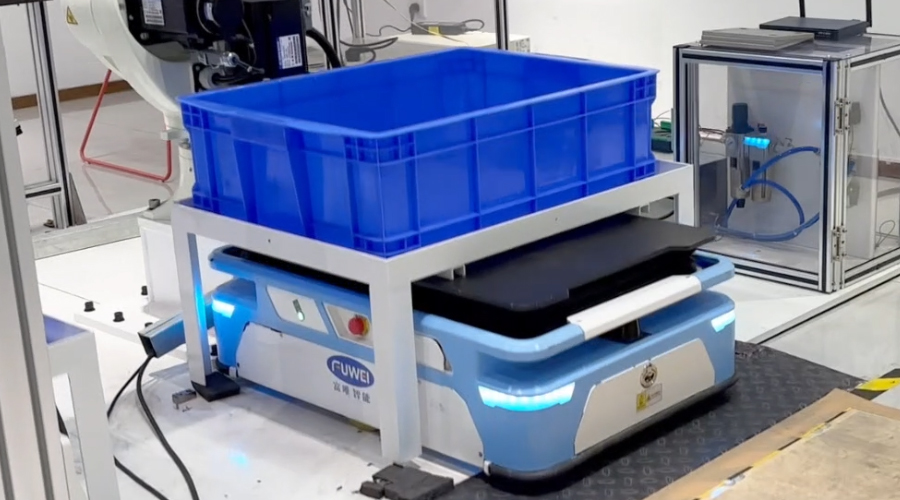
Are you facing these "pain points of heavy-load handling"?
Pain Point 1: Complex factory environment and difficulty in multi-robot collaborative avoidance
Multiple AGVs work alongside heavy-load equipment in the same area. Narrow passages and mixed flow of personnel and vehicles lead to frequent path conflicts and complex avoidance decisions among robots, which traditional scheduling systems struggle to handle.
Pain Point 2: High navigation accuracy requirement and difficulty guaranteeing positioning consistency
AGVs need precise docking at dense production stations with millimeter-level parking positioning accuracy. Traditional magnetic stripe or QR code navigation is prone to wear and high maintenance costs. Single navigation mode suffers poor reliability under complex lighting and ground reflection conditions.
Pain Point 3: Frequent signal interaction, and network stability becomes a bottleneck
Frequent operation signal exchanges between AGVs and on-site management systems (MES, WMS) impose high requirements on network real-time performance and stability. Once signal loss occurs, it may trigger task interruption, material mismatch and other cascading problems.
Pain Point 4: Large product size, unstable center of gravity and prominent operational safety hazards
Heavy products transferred on-site feature large dimensions and irregular shapes, making it hard to accurately predict the center of gravity. The inertial force generated during start-up, braking and steering under heavy load rises geometrically. Experimental data shows that the inertial impact during emergency stop under 10-ton load can reach more than 15 times of the normal load, bringing extremely high challenges to equipment operation stability and safety.
Our Solution: AI Edge Controller + Laser SLAM Navigation + Anti-sway Technology to Systematically Solve Heavy-load Handling Challenges
Core 1: FUWEI AI Edge Controller — Solve integration problems of "frequent signal interaction and difficult system docking"
Pain Point: Frequent signal exchanges between AGVs and MES/WMS with easy packet loss; complicated docking for multi-brand and multi-protocol devices.
Solution: Adopt FUWEI AI Edge Controller as the master controller of the production site to realize signal interaction and instruction forwarding among AGV transfer robots, production equipment and customer on-site management systems. The edge controller integrates multiple communication interfaces and supports standard industrial protocols including Modbus TCP, OPC UA and EtherCAT. It effectively reduces network latency and packet loss rate.
Value Output: System integration cycle shortened from several months to several weeks; zero packet loss and zero latency for signal interaction, task execution accuracy raised to over 99.9%.
Core 2: Self-developed Robot Integrated Control System — Solve management problems of "difficult multi-robot collaboration and low scheduling efficiency"
Pain Point: Frequent path conflicts, uneven task allocation and messy charging management when multiple AGVs operate simultaneously.
Solution: Deploy self-developed robot integrated control system for unified scheduling, task assignment, intelligent avoidance and flexible charging of multiple AGVs. Based on reinforcement learning algorithms, it can schedule more than 100 AGVs at the same time, automatically avoiding route conflicts. Multi-robot collaboration efficiency improved by over 35%, and congestion rate reduced below 0.5%.
Technical Highlights: Based on integrated cost function, the globally optimal task allocation scheme is considered from bottom layer to maximize robot utilization rate. The system can automatically plan charging timing for each robot to realize "uninterrupted charging", ensuring no impact on production takt.
Value Output: Multi-robot collaboration efficiency increased by over 50%, empty load rate reduced by 60%, charging management fully automated.
Core 3: Laser SLAM Navigation + High-precision Positioning — Solve execution problems of "low navigation precision and poor environmental adaptability"
Pain Point: Complex factory environment, uneven ground and variable lighting make traditional navigation modes hard to adapt.
Solution: AGV transfer robots adopt Laser SLAM navigation technology. It scans the environment via laser radar to generate 3D maps without magnetic stripes or QR codes, achieving parking positioning accuracy of ±5mm. Combined with FUWEI self-developed high-sensitivity slip positioning algorithm, the robot can quickly re-calibrate its position after slipping.
Technical Highlight: Laser SLAM + vision fusion navigation delivers millimeter-level positioning through environmental feature matching in GPS-denied indoor scenarios, adapting to dynamically changing factory environments. Dual LiDAR + AI visual dynamic compensation, through millimeter-level environment modeling and real-time path planning, achieves a grasping success rate of 99.98% in complex scenarios.
Value Output: No environment reconstruction required for navigation system, deployment cost cut by 80%. Positioning consistency and reliability reach industrial standards.
Core 4: Multi-axis Coordinated Control & Mechanical Vibration Damping System — Solve safety problems of "unstable and shaking operation under heavy load"
Pain Point: Large size of transferred on-site products, unstable center of gravity, severe shaking during start-up, braking and steering under heavy load.
Solution
Multi-axis Coordinated Control: Combined application of BAS-PID fusion algorithm and LQR optimal control theory improves the control precision of heavy-load AGV by more than 40% under 30-ton load. According to control algorithm comparison data, the response time of LQR optimal control is only 150ms, overshoot 2.1%, settling time 350ms, far superior to traditional PID algorithm.
Mechanical Damping System: Adopt lever-type vibration damping mechanism. The mechanical lever connects front wheels and middle drive wheels to realize uniform load distribution. Experimental data shows that under working conditions of 20-ton load and speed of 8km/h, the body vibration amplitude of the lever damping vehicle is 35% lower than that of six-wheel independent damping mechanism, and operation stability index increased by 42%.
Precision Parking Technology: Load prediction model based on motor current characteristics. Real-time monitoring of drive motor current data to accurately predict load changes with relative error controlled within 3%. The application of curvature-oriented trajectory fusion algorithm reduces start-stop times of AGV when passing through waypoints by 4 times, and operation efficiency increases by 35.7%.
Value Output: Operation stability improved by over 40% under heavy load conditions, goods are free from tipping and damage, and equipment service life is extended.
Core 5: 600kg Load AGV + Platform Adaptation Design — Solve adaptation problems of "large product size and unstable transfer"
Pain Point: Large size and various shapes of on-site transferred products with hard-to-control center of gravity.
Solution: Adopt 600kg load AGV transfer robot (optional upgrade up to 80-ton full-load coverage). Its transfer platform matches product dimensions. By lowering robot movement speed and combining lever damping mechanism and multi-axis coordinated control, product transfer stability is guaranteed.
Value Output: Zero damage during product transfer, controllable full-process stability, meeting heavy material handling demands of various industries.
Why Choose Our Solution?
| Dimension | Traditional Manual / Basic AGV Solution | Heavy-load AGV Transfer Robot Solution | Improvement |
|---|
| Load Capacity | Limited by manpower and equipment | Full-load coverage from 600kg to 80 tons | Meet heavy industrial demands |
| Operation Stability | Severe shaking under heavy load, high safety risks | Multi-axis coordination + mechanical damping, zero shaking | Stability improved by over 40% |
| Navigation Precision | Magnetic stripe/QR code prone to wear | Laser SLAM, ±5mm parking accuracy | Precision improved by 10 times |
| Multi-robot Collaboration | Frequent path conflicts, low scheduling efficiency | Integrated scheduling & intelligent avoidance | Efficiency increased by over 35% |
| System Integration | Multiple independent systems, complex docking | Unified scheduling via AI edge controller | Integration cycle shortened by 70% |
| Non-stop Operation | Requires manual shift change | Automatic charging, 7×24h operation | Throughput increased by 200% |
Relevant Cases