2D Vision Guided Automatic Loading & Unloading Solution for Material Bins: Liberate Material Flow from "Man Waiting for Material & Material Waiting for Man"
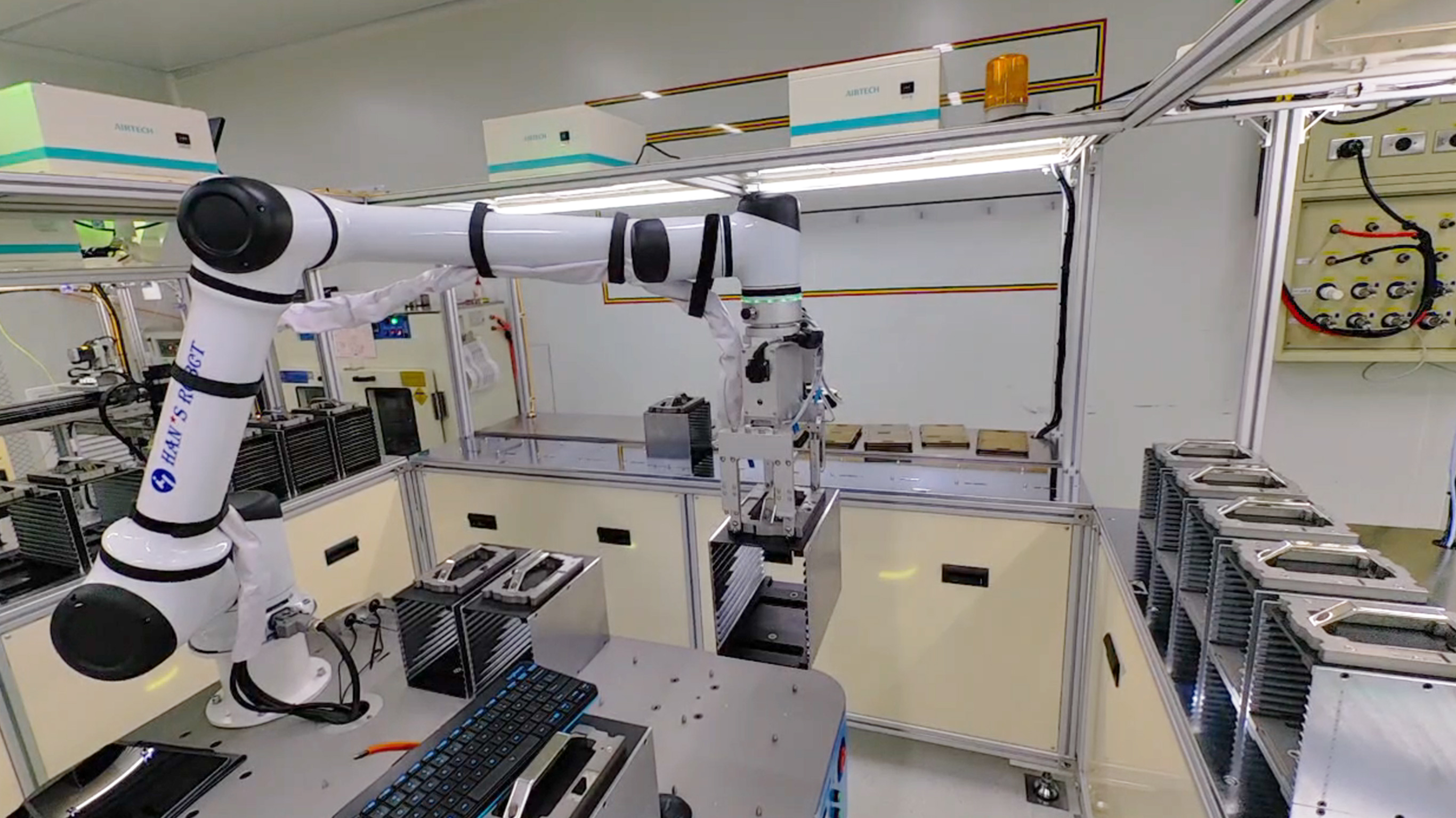
Overview
In precision production lines of 3C electronics, semiconductors, pharmaceuticals and other industries, frequent loading and unloading of material bins has become a key bottleneck restricting efficiency. Centered on 2D vision + AMR composite robot + intelligent scheduling system, we provide intelligent loading & unloading capability featuring "precise pick-and-place, multi-robot collaboration and 7×24-hour non-stop operation" for electronic components, semiconductor trays and other scenarios. Enable every equipment to operate with "equipment waiting for personnel" instead of "personnel waiting for equipment", fully tapping the potential of production line efficiency.
Quick Overview of Core Values
Efficient Multi-robot Collaboration: Self-developed scheduling system supports multiple AMRs for independent, alternating and interleaved operations to optimize resource allocation.
Precision Assurance: Self-developed 2D calibration and positioning algorithm achieves high-precision placement to meet stringent workstation docking requirements.
Ultra-long Endurance: Equipped with 72AH high-capacity battery, up to 16 hours of continuous operation to support 24-hour uninterrupted production.
Intelligent Charging Management: The scheduling system automatically plans charging time without disrupting production takt.
Low-vibration Design: No workpiece dislodging after 72 hours of continuous operation to safeguard delicate precision components.
Are you facing these "pain points of material loading & unloading"?
Pain Point 1: Difficult multi-robot collaboration restricts operational efficiency
The customer is a technology enterprise specializing in R&D, production and sales of electronic components, covering semiconductors, capacitors, resistors, motors and other products. Two AMRs are required to perform independent, alternating and interleaved operations on-site. However, traditional scheduling schemes struggle with complex multi-robot collaboration scenarios, prone to path conflicts and uneven task allocation, limiting overall efficiency.
Pain Point 2: Numerous workstations with complex priority allocation
There are a large number of workstations on-site, and different workstations have varying urgency levels for material bin supply. Reasonably assigning delivery priority of material bins to ensure no material shortage at key workstations is a core scheduling challenge to be solved.
Pain Point 3: Dual challenges of endurance and charging management
Production lines require 7×24-hour continuous production, imposing high requirements on AMR endurance: single-run endurance must exceed 12 hours. Meanwhile, when robots should charge and how to complete charging without interrupting production becomes a tough operation and maintenance problem.
Pain Point 4: Precision materials are extremely sensitive to vibration
Precision electronic components are placed inside material bins. Robots must ensure components do not shake out of tray grooves during pick, place and transportation, setting stringent requirements on robot motion control and stability.
Pain Point 5: High placement precision requirement with narrow error tolerance
Material bins require extremely high placement precision at workstations. Excessive deviation will prevent subsequent equipment from picking or processing normally. Traditional AMRs cannot guarantee consistent positioning accuracy after repeated operations.
Our Solution: Intelligent Scheduling + Precision Vision + Ultra-long Endurance to Systematically Resolve Material Loading & Unloading Challenges
Core 1: Self-developed AMR Scheduling System — Solve scheduling problems of "difficult multi-robot collaboration & chaotic priority allocation"
Pain Point: Two AMRs need independent, alternating and interleaved operations; traditional scheduling solutions lead to conflicts and low efficiency.
Solution: Adopt self-developed AMR scheduling system with built-in robot path search and traffic management functions. It can effectively predict and resolve deadlocks to realize independent, alternating and interleaved operations for multiple robots and rationalize on-site resource allocation.
Technical Highlight: Based on integrated cost function, the globally optimal task allocation scheme is considered from the bottom layer. It provides a "carpooling mode" for multi-station robots to fulfill material bin transportation demand via the shortest path, maximizing robot utilization and transport efficiency while eliminating empty-running losses.
Value Output: Multi-robot collaboration efficiency increased by over 50%, resource utilization maximized, empty load rate reduced by 60%.
Core 2: 2D Vision Guidance & High-precision Positioning — Solve precision problems of "inaccurate placement & misalignment"
Pain Point: Material bins demand high placement precision; traditional AMRs suffer poor positioning consistency.
Solution: Integrate self-developed 2D calibration and positioning algorithm. Real-time identification of workpiece markers via vision system guides the manipulator to perform precise pick-and-place, ensuring every placement stays within allowable error range.
Value Output: Placement precision reaches leading industry level, eliminating equipment downtime caused by positioning deviation.
Core 3: Ultra-long Endurance & Intelligent Charging Management — Solve operation problems of "short endurance & chaotic charging"
Pain Point: 24-hour continuous production requires endurance over 12 hours, and charging must not affect production takt.
Solution: Equipped with 72AH high-capacity lithium battery, delivering up to 16 hours of endurance, well exceeding the 12-hour threshold. The scheduling system embeds an intelligent charging management module. It automatically plans charging timing and duration for each robot according to multi-dimensional factors including real-time workload, power threshold and workstation idle time, achieving "uninterrupted charging".
Value Output: 7×24-hour non-stop operation, charging completely free from production disruption, automated operation and maintenance management.
Core 4: Low-vibration Motion Control — Solve safety problems of "precision material dislodging"
Pain Point: Electronic components are vibration-sensitive and easily shake out of tray grooves during transportation.
Solution: Optimized motion control algorithm and path planning strategy realize low-vibration stable robot operation. Measured data shows no workpiece dislodging after 72 hours of continuous running.
Value Output: Zero damage to parts, guaranteed product quality and reduced scrap rate.
Summary of Core Technical Indicators
| No. | Technical Element | Core Indicator | Solved Pain Point |
|---|
| 1 | Self-developed Scheduling System | Multi-robot collaboration & path optimization | Difficult multi-robot collaboration & chaotic priority allocation |
| 2 | 2D Vision Positioning | High-precision placement | High workstation docking precision requirement |
| 3 | High-capacity Battery | 16h endurance | 24h continuous production demand |
| 4 | Intelligent Charging Management | Automatic charging planning | Charging does not disrupt production takt |
| 5 | Low-vibration Control | No dislodging within 72h | Precision material safety |
Why Choose Our Solution?
| Dimension | Traditional Manual / Basic AGV Solution | Intelligent Composite Robot Solution | Improvement |
|---|
| Collaboration Efficiency | Single machine operation, frequent path conflicts | Multi-robot collaboration & intelligent scheduling | Efficiency increased by over 50% |
| Placement Precision | Poor repeat positioning consistency | 2D vision guidance, high precision | Precision improved by 5 times |
| Endurance Capacity | Below 8h, frequent recharging | 16h ultra-long endurance | Endurance improved by 100% |
| Charging Management | Manual scheduling, easy production disruption | Automatic planning, "uninterrupted charging" | O&M efficiency increased by 80% |
| Material Safety | Uncontrollable vibration, prone to damage | Low-vibration control, zero dislodging | Scrap rate close to zero |
| Deployment Cycle | Weeks to months | Modular design, rapid deployment | Delivery efficiency increased by 90% |