3D Vision Guided Goods Sorting & Random Bin Picking Solution: Enable Robots to "Perceive" and "Grasp Precisely" in Complex Environments
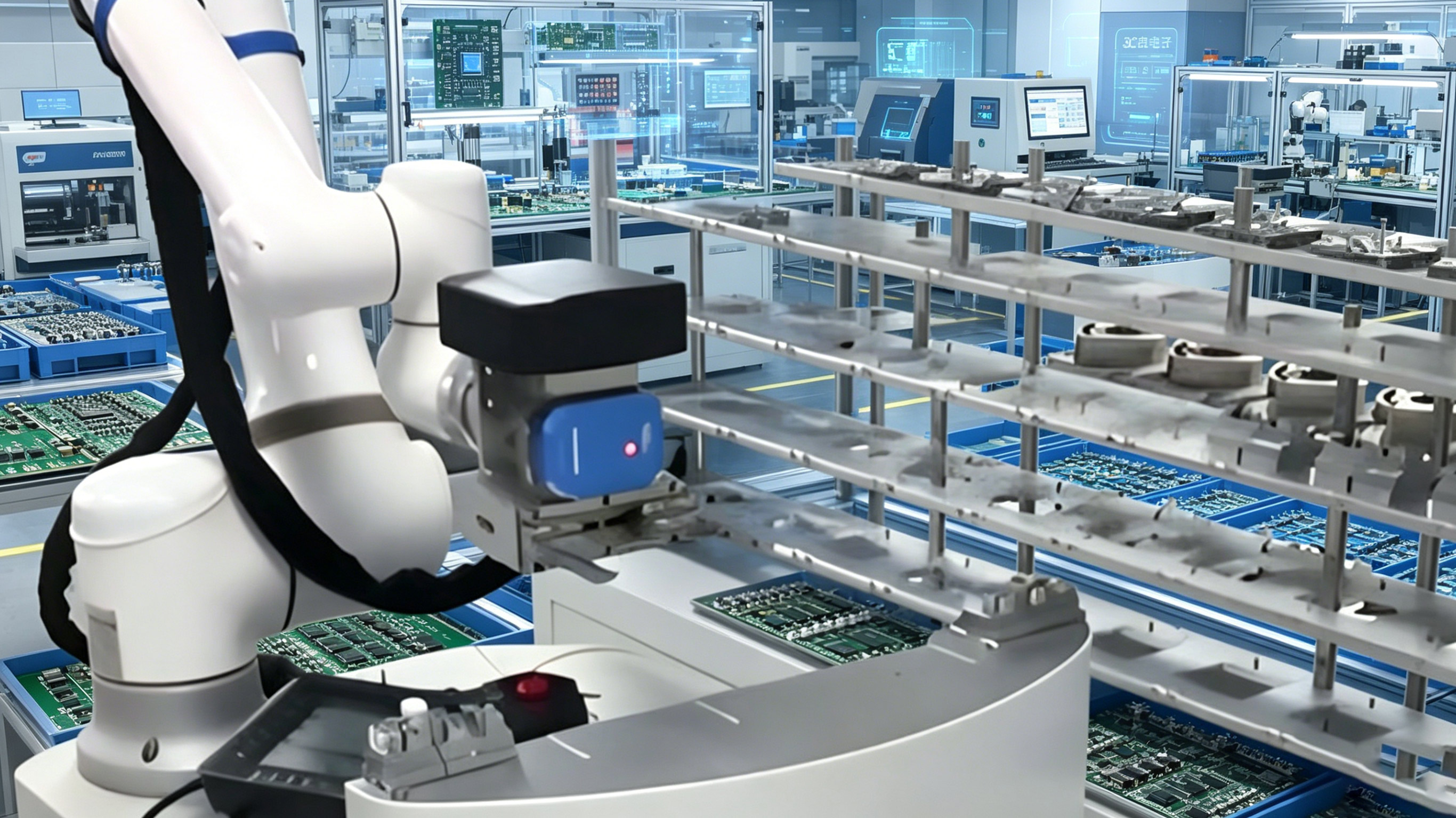
Overview
In production lines of 3C electronics, auto parts, pharmaceuticals and other industries, common pain points include a wide variety of tooling fixtures, disordered incoming materials and frequent product changeovers. Centered on 3D vision + composite robot + AI algorithm, we deliver flexible automation capability of “accurate picking at first sight” for workpiece transfer, loading and sorting scenarios. It empowers robots to evolve from following "fixed programming" toward "self-adaptive perception", completely eliminating reliance on manual part arrangement and custom fixtures.
Quick Overview of Core Values
Flexibility Upgrade: Compatible with over 40 types of tooling fixtures; product changeovers require no mechanical adjustment and support rapid switching via graphical configuration.
Precision Breakthrough: 3D vision positioning accuracy reaches ±0.25mm; pin alignment accuracy is controlled within ±2mm.
Efficiency Revolution: 7×24-hour non-stop operation, replacing repeated manual fetching and handling. Production line response speed increased by 300%.
Environmental Adaptability: Strong anti-interference capability, adapting to industrial environments with varying lighting, oil stains and reflective surfaces.
Rapid Deployment: Modular design, deployment and commissioning completed within 3 days, compatible with multiple robot brands.
Are you facing these "pain points of flexible production"?
Pain Point 1: Time-consuming product changeovers and low manual handling efficiency
The customer is a high-tech enterprise specializing in R&D and manufacturing of connectors for aerospace, military, automotive and communication industries. Each product changeover requires workers to transport more than 40 sets of fixtures and carriers from fixture warehouses to fixed line-side positions. The whole process is time-consuming and error-prone, severely restricting production line response speed.
Pain Point 2: Complex factory environments with drastic lighting variations
Actual production sites are not ideal laboratories. Lighting fluctuates sharply and there are oily and reflective surfaces. Traditional 2D vision is prone to misrecognition or failure and cannot operate stably.
Pain Point 3: Wide variety of tooling fixtures hard to be universally adapted
From dozens of fixtures of different sizes and materials to diverse carriers, conventional non-standard automation lacks flexibility when facing diversified demands, resulting in high changeover cost and long lead time.
Pain Point 4: Strict precision requirement with pin alignment error controlled within 2mm
High-precision assembly scenarios demand extremely high pin alignment accuracy between fixtures and workstations. Manual operation cannot maintain stable accuracy over long periods, while ordinary automation schemes fail to meet sub-millimeter positioning standards required by the industry.
Pain Point 5: Traditional automation cannot support rapid switching of multiple products
Market competition intensifies and product iteration accelerates. Traditional fixed automation equipment cannot keep up with the flexible production rhythm of "small batches and multiple varieties", becoming a bottleneck restricting enterprises’ digital transformation.
Our Solution: 3D Vision + Composite Robot, "Four-in-One" System to Systematically Solve Flexible Loading Challenges
Core 1: 3D Vision — Enable Robots to "See" the World
Pain Point: Factory sites feature complex lighting and various irregularly shaped tooling fixtures. Traditional 2D vision cannot obtain depth information and suffers low recognition rates.
Solution: Adopt a 3D structured light camera. It projects encoded patterns onto object surfaces and generates high-precision 3D point cloud data in real time to acquire objects’ spatial coordinates (X/Y/Z) and pose angles (rotation/tilt).
Accurate recognition is achievable even for stacked, occluded or reflective workpieces.
Technical Highlight: Supports simultaneous processing of point cloud data from more than 200 workpieces with processing time less than 3 seconds.
Precision Index: Positioning accuracy up to ±0.25mm; pin alignment accuracy controlled within ±2mm.
Value Output: Eliminate manual part arrangement and custom fixtures. Robots can accurately pick workpieces even with disordered incoming materials, greatly improving flexibility.
Core 2: Composite Robot — Realize Coordination of "Hand-Eye-Foot"
Pain Point: Traditional fixed robotic arms only operate at a single workstation and cannot transport tooling fixtures across zones. AGVs can only transport goods and cannot perform precise manipulation.
Solution: The composite robot integrates the "mobility" of AMR (Autonomous Mobile Robot) and the "manipulation" of collaborative robotic arms to form an integrated "hand-eye-foot" intelligent unit. It can autonomously navigate from fixture warehouses to target positions, use 3D vision to guide the robotic arm to accurately grab fixtures, then transport and place them at line-side workstations.
Navigation Technology: Laser SLAM navigation with parking positioning accuracy of ±5mm, no magnetic strips or QR codes required.
Endurance: Supports automatic charging; it automatically recharges when power drops below the preset threshold to meet 7×24-hour non-stop operation.
Value Output: One composite robot can cover multiple workstations across an entire workshop, realizing full-process "Fetch-Transport-Place" automation and cutting labor costs by over 60%.
Core 3: AI Algorithm — Make Operations Smarter
Pain Point: Different workpieces require different grasping strategies. A single grasping mode cannot adapt to multi-variety production.
Solution: Integrated deep learning AI algorithm can automatically learn and optimize workpiece recognition, classification and grasping strategies. The algorithm can:
Identify whether workpieces in bins are occluded and intelligently select optimal grasping points
Plan motion paths for robotic arms in real time to avoid collisions with bins and fixtures
Dynamically compensate position deviation after AMR parking to ensure "accurate grasping upon arrival"
Value Output: The system gets smarter with usage. Recognition accuracy reaches over 95%, and grasping success rate >99.5%.
Core 4: Integrated Control Platform — Achieve Unified Scheduling of the "Brain"
Pain Point: Coordinated scheduling of multiple devices (AMR, robotic arm, 3D camera) is complex. Traditional multi-system integration features long cycles and high maintenance costs.
Solution: Adopt an AI edge integrated controller. It unifies motion control, 3D vision, data acquisition and edge computing onto one single platform, realizing "one controller for full-system scheduling". It supports standard industrial protocols (Modbus TCP, OPC UA, EtherCAT) and seamlessly connects with customer MES/WMS systems.
Value Output: Deployment cycle shortened to 3 days, system plug-and-play, and operation & maintenance barriers greatly reduced.
Summary of Core Technical Indicators
| No. | Technical Element | Core Indicator | Solved Pain Point |
|---|
| 1 | 3D Structured Light Camera | Positioning accuracy ±0.25mm | Recognition under complex lighting & reflective surfaces |
| 2 | Laser SLAM Navigation | Parking accuracy ±5mm | No magnetic strips or QR codes needed |
| 3 | Pin Alignment | Accuracy ≤2mm | High demand for precision assembly |
| 4 | Automatic Charging | 7×24h non-stop operation | Requirement for long continuous production cycles |
| 5 | Control System | Integrated scheduling | Complex multi-system integration |
Why Choose Our Solution?
| Dimension | Traditional Manual / Fixed Automation | Intelligent Composite Robot Solution | Improvement |
|---|
| Flexibility | Mechanical adjustment required for changeover, long cycle | Graphical configuration, zero mechanical adjustment for changeover | Changeover time reduced by 90% |
| Precision | Affected by fatigue, high error rate | 3D vision guidance, ±0.25mm accuracy | Precision improved by 10 times |
| Efficiency | Low daily throughput, hard to sustain | 7×24h continuous operation + automatic charging | Throughput increased by 300% |
| Compatibility | Handling limited types of fixtures | Unified visual recognition, adaptive grasping | Compatible with over 95% fixtures |
| Deployment | Renovation cycle: weeks to months | Modular design, finished in 3 days | Delivery efficiency increased by 95% |